WHY SOME ROOMS FEEL INSTANTLY CALM AND OTHERS NEVER DO — IT'S NOT THE DÉCOR

You walk into a room and something settles in your chest. You don't know why. You just want to stay.
You walk into another room — same price point, same furniture, same Pinterest-worthy palette — and something feels slightly off. Not wrong enough to name. Just... not right.
Most people blame the décor. The wrong sofa. The wrong colour. Not enough plants. So they keep buying, keep rearranging, keep repainting. And the feeling never quite arrives.
Here's what I've learned after 12 years of designing spaces professionally: the feeling was never about the décor.
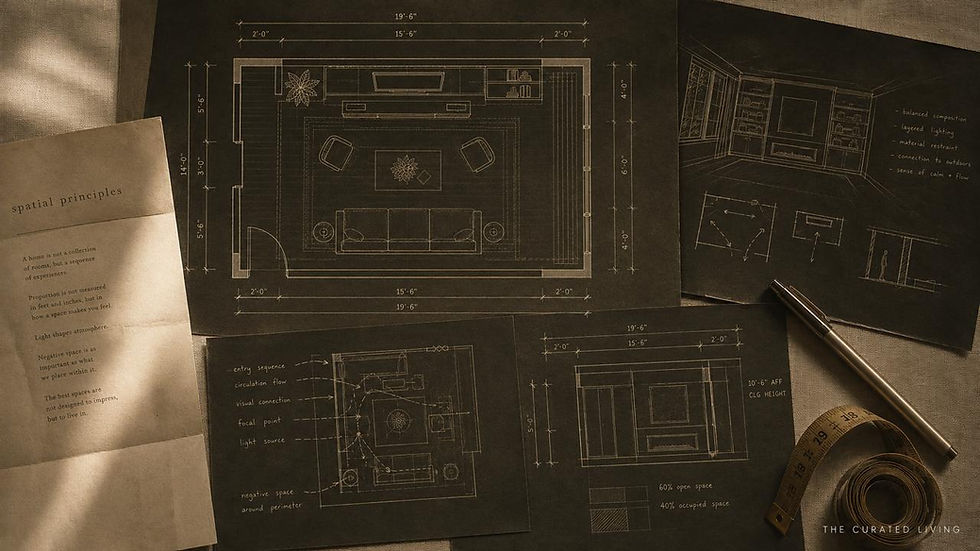
What Architects See That Most People Don't
When an architect walks into a room, they're not looking at what you're looking at.
They're not seeing the cushions or the coffee table styling. They're reading the room itself — the proportions, the way light moves, where the eye lands first, how the space breathes between objects.
There is a spatial logic underneath every room that either works or doesn't. When it works, the room feels calm, grounded, complete. When it doesn't, no amount of styling fixes it. You're decorating over a problem that was never a decoration problem to begin with.
This is what most interior content never talks about — because it's harder to sell than a new throw pillow.
The training an architect goes through isn't just technical. It's perceptual. You learn to read a space the way a musician reads a score — not note by note, but as a whole system. You start to see relationships between elements that most people experience only as feelings. The distance between a sofa and a wall. The height of a ceiling relative to the floor area. The ratio of solid to void in a room. These aren't decorative decisions. They're spatial ones. And they determine everything about how a room feels before a single cushion is placed.

The Feeling Has a Structure
Understanding why rooms feel calm starts with one uncomfortable truth — calm is not random.
It's not a mood or a vibe or a lucky accident. It's the result of specific spatial relationships doing their job quietly in the background.
Think about the last space that made you feel instantly at ease. A hotel lobby. A friend's living room. A café you didn't want to leave. Now think about what they had in common — not aesthetically, but spatially.
There was probably a clear sense of where to look first. A natural path your eye followed without effort. A point of stillness somewhere in the room that everything else seemed to orbit around. Light arriving from a deliberate direction. A sense that the room knew exactly how big it needed to be — not cramped, not cavernous, just right.
That's not coincidence. That's spatial design working exactly as it should.
Now think about a room that never felt right despite looking good on paper. Chances are one or more of those things was missing. No clear focal point. Light coming from too many directions at once. Furniture scaled wrong for the floor area. A layout that forced your eye to travel without ever landing anywhere restful.
The room wasn't ugly. It was spatially unresolved. And no amount of styling resolves a spatial problem.
Why Décor Can't Fix a Spatial Problem
This is the part that most homeowners find frustrating — because it means the answer isn't on a shopping page.
Furniture arrangement, colour palettes, and styling are the final 20% of a room. They matter enormously — but only after the underlying spatial logic is sound. When that foundation is missing, every decorating decision you make is built on unstable ground.
When spatial logic is missing, the room fights you. You feel restless without knowing why. Conversations feel harder in that room than in others. Focus doesn't come. You find yourself gravitating to one corner and avoiding the rest. You leave the room more than you stay in it.
You repaint. You buy a new rug. You rearrange the furniture for the fourth time. And something still feels off.
No scented candle fixes this. No gallery wall fixes this. The solution sits at a completely different level of the design — one that most homeowners have never been shown how to access, because most interior content stops at the surface.
The surface is where the pretty pictures are. But the feeling lives underneath.
If you've ever wondered why rooms feel calm the moment you walk in — while others never do — the answer isn't hanging on your walls.

The Spaces That Get It Right
Walk into any space that genuinely stops you — makes you look up and slow down — and you'll find the same thing every time. The spatial decisions were made first. The decorative decisions came after, in service of those spatial decisions.
The great hotel lobbies. The restaurants you return to not just for the food but for how you feel inside them. The homes of people who seem to have figured something out that you haven't been able to name.
They all share this: someone understood the room before they furnished it.
They knew where the eye needed to land. They knew which wall should carry weight and which should breathe. They understood the relationship between the floor plane and the ceiling. They created a clear centre — not necessarily in the geometric middle of the room, but a point of gravity that everything else acknowledged.
Think about a living room you've walked into and immediately felt at ease. Chances are the sofa wasn't pushed against the wall. There was breathing room behind it. The furniture created a defined zone within the larger room — not scattered across it. One wall held your attention. The others receded. Light came from one primary direction, not bouncing from four different sources creating visual noise.
None of those decisions were accidental. None of them were about the cushion covers or the paint colour. They were spatial decisions made before anything was purchased or placed. The styling that came after simply honoured what the space had already established.
This is spatial thinking. And it is learnable.
There's a Framework for This
The reason why rooms feel calm isn't mysterious — architects don't design it by feel.. They work with principles — spatial principles that govern how a room is experienced before a single piece of furniture enters it.
These principles have been understood for centuries. They exist in classical architecture across every culture — in the proportional systems of ancient India, in the spatial philosophy of Japanese design, in the compositional logic of Renaissance interiors. They aren't trends. They don't expire. They work because they're rooted in how human beings perceive and inhabit space — and that hasn't changed.
What has changed is access. These principles have lived in architectural education, in technical texts, in the working knowledge of trained designers. They've never been translated into something a homeowner could actually pick up and use.
That is something I've been working on for a while now.

More Soon
I'm not ready to share everything yet. But if you've ever stood in a room that felt wrong and couldn't explain why — if you've ever felt like your home is almost right but not quite — what I'm building is for you.
It's rooted in spatial principles that architects have used for centuries. It's practical enough to apply to your home. And it's coming soon.
Subscribe below to be the first to know when it's ready.
In the meantime, if you're actively working on your space right now — Start with the free guides — no commitment, just good design thinking straight to you.
Start here — it's free: 👉 Download the Free Colour Starter Guide
Take it further: 👉 Colour Your Space Workbook — ₹199 for Indian buyers
👉 Colour & Your Home: The Complete Guide — ₹449 for Indian buyers
The essential starting point for every kitchen renovation.
The Compact Kitchen Design Guide by The Curated Living gives you that complete framework, with real market costs and a pre-execution checklist built specifically for this moment.


Comments