Small Room Furniture Rules: What Every Compact Space Actually Needs

Most small rooms don't have a size problem. They have a furniture problem.
The sofa is two inches too long. The dining table seats six in a room that comfortably fits four. The wardrobe is tall enough to make the ceiling feel low. None of these decisions were made carelessly — they were made without a framework. And without a framework, small rooms almost always end up feeling smaller than they are.
The good news is that small rooms are not a design limitation. They are a design brief. One that rewards precision, editing, and a few specific rules that architects and interior designers apply every single time.
Here are those furniture rules — applied to the rooms you actually live in.
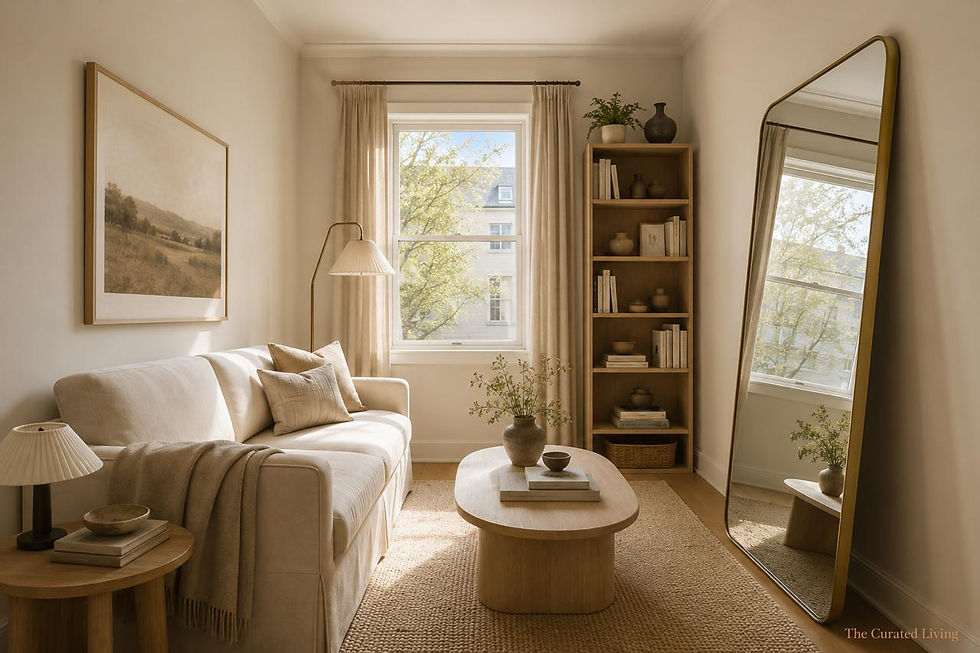
Small Room Furniture Rules Start With Scale
The single most important decision in any small room is the scale of the furniture you put in it.
This sounds obvious. It isn't — because most people think of furniture scale in isolation. They measure the sofa, check it fits the wall, and stop there. What they don't consider is how the furniture relates to the room as a whole — to the ceiling height, to the other pieces around it, to the amount of floor that remains visible once everything is in place.
Visible floor space is what makes a room feel larger. The more floor you can see, the more generous the space feels. This is why low-profile furniture — beds close to the ground, sofas without heavy skirting, coffee tables with slim legs — works so well in small rooms. It's not about the furniture being small. It's about the furniture feeling light.
The rule: choose furniture that sits on legs rather than to the floor wherever possible. A sofa on legs shows the floor beneath it. A sofa with a solid base blocks it. The difference in how the room feels is immediate and significant.
"Visible floor space is what makes a small room feel larger — not the furniture you remove."
One Large Piece, Not Many Small Ones
Here is a rule that surprises most people: in a small room, one large well-chosen piece of furniture works better than several small mismatched ones.
This is counterintuitive. The instinct in a small room is to buy small — a tiny sofa, a little side table, a compact bookshelf. The result is a room full of furniture that feels fussy and cluttered, with nothing anchoring the space.
A single large mirror. One generous sofa. A full-height bookshelf on one wall. These create scale and purpose. They give the eye somewhere to land and rest. Small rooms need anchors just as much as large ones do — perhaps more.
The rule is this: identify the one piece of furniture the room is built around, invest in getting that right, and edit everything else down to what is strictly necessary. A small living room built around one good sofa, a correct rug, and a large mirror will always feel more resolved than one filled with six smaller pieces that fight each other for attention.

Small Room Furniture Rules: Always Choose Round Tables
If there is one single piece of advice that applies to almost every small dining room or kitchen, it is this: choose a round table.
The reason is spatial, not aesthetic. A rectangular table has four corners — and each corner cuts into the circulation path around it. In a small room, those corners make the space feel tight and difficult to navigate. A round table has no corners. Movement flows around it naturally. Chairs tuck under it more completely. The same number of people can sit at a smaller footprint.
A round pedestal table — one with a single central leg rather than four legs at the corners — is even better. It allows chairs to be placed anywhere around the circumference and pulled out without hitting a table leg. In a small dining room, this single decision can make the difference between a space that feels workable and one that feels genuinely comfortable.
The rule: if your dining area is under four metres in either direction, a round table is almost always the better spatial choice.
"A round table doesn't just save space. It changes how the whole room moves."
Mount Things on Walls
Every surface a piece of furniture occupies is floor space that disappears. In a small room, moving storage and function to the walls is one of the highest-impact decisions you can make.
Wall-mounted bedside lights instead of table lamps free up the entire bedside table surface — or eliminate the need for a table altogether. A wall-mounted shelf above a desk replaces a bulky bookshelf on the floor. A narrow floating console in a hallway gives you surface and storage without the footprint of a freestanding piece.
The wall is free real estate that most people in small spaces completely ignore.
This principle extends to mirrors. A large mirror mounted on or leaning against a wall opposite a window doubles the perceived depth of the room. It is one of the oldest spatial tricks in design — and it works every single time, without exception. The mirror should be large — at least 80 centimetres wide — to have a meaningful impact on the room's sense of space.

The Rug Rule in Small Rooms
Rugs in small rooms are where most people make a costly mistake — and it is almost always the same mistake. The rug is too small.
A small rug in a small room does not make the room feel larger. It makes it feel more fragmented — like a postage stamp floating in the centre of the floor, unconnected to anything around it. The instinct to "not overwhelm" a small room with a large rug is exactly backwards.
In a small living room, the rug should be large enough for at least the front legs of every piece of seating to sit on it. In a small bedroom, the rug should extend at least 50 centimetres beyond the sides and foot of the bed. These proportions are what create a sense of ground — of the furniture belonging to the room rather than sitting in it randomly.
The rule: always buy one size larger than feels right. The rug you think is too big for a small room is almost always the correct one.
"The rug you think is too big is almost always the right one."
Vertical Space Is Untapped Space
Small rooms tend to expand horizontally — low furniture, wide layouts, floor-level thinking. But the most underused dimension in any small room is height.
Tall bookshelves that reach close to the ceiling draw the eye upward and make the room feel taller. Curtains hung as close to the ceiling as possible — regardless of where the window actually ends — create the illusion of full-height windows and generous ceiling height. A tall narrow plant in a corner adds vertical scale without taking significant floor space.
Thinking vertically is one of the most effective tools in small room design — and one of the least used.
The rule: in every small room, identify at least one vertical element that draws the eye upward. It costs almost nothing and changes how the room feels entirely.

The Edit Is the Design
Every rule above points to the same underlying principle: in a small room, editing is designing.
The decision to remove something is as important as the decision to add something. The choice to leave floor space clear, to keep walls from becoming cluttered, to resist the impulse to fill every corner — these are active design decisions, not passive ones.
Small rooms reward restraint. Not because they can't hold more, but because every piece you add in a limited space has a proportionally larger impact on how the whole room feels. One wrong piece in a large room goes unnoticed. One wrong piece in a small room defines it.
The most beautifully designed small rooms are not the ones that found clever ways to fit more in. They are the ones that found the discipline to keep less — and made every single thing that remained count.
Start with less than you think you need. Then add back only what earns its place.
"Small rooms don't reward more. They reward better."
Want to go deeper into your home design?
Start with the free guides — no commitment, just good design thinking straight to you.
Start here — it's free: 👉 Download the Free Colour Starter Guide
Take it further: 👉 Colour Your Space Workbook — ₹199 for Indian buyers
👉 Colour & Your Home: The Complete Guide — ₹449 for Indian buyers
The essential starting point for every kitchen renovation.
The Compact Kitchen Design Guide by The Curated Living gives you that complete framework, with real market costs and a pre-execution checklist built specifically for this moment.


Comments