Natural Light Home Design: The Light You Already Have

There is a version of your home that costs nothing to achieve. No new furniture. No renovation. No mood board. It exists in the hours between 7am and 4pm, moving slowly across your walls, shifting from cool silver in the morning to warm amber by afternoon — and most people completely miss it.
Natural light is the single most powerful design tool in a home. Architects obsess over it before choosing a single finish, a single tile, a single paint colour. And yet it's almost always the last thing homeowners think about — if they think about it at all.
This isn't a post about adding more windows or tearing down walls. It's about understanding the light you already have, and learning to work with it the way someone who designs spaces for a living would.

Why Natural Light home design Changes Everything (Before Anything Else Does)
Here's something most people don't realise: the same room can feel completely different at 8am versus 3pm. The same sofa. The same rug. The same paint on the walls. But the quality of the space shifts entirely based on where the light is coming from, how direct it is, and what it's landing on.
This is why architects always — always — ask about orientation before anything else.
→ North-facing rooms get soft, diffused light that barely changes through the day.
→ South-facing rooms get dramatic sun that moves fast and casts strong shadows.
→ East-facing rooms are luminous at breakfast and flat by noon.
→ West-facing rooms are dark in the morning and beautifully golden by late afternoon.
None of these is better than the other. But each one calls for a completely different design response.
If you've ever painted a room a colour that looked perfect on the chip and then felt wrong on the wall — this is usually why. Light changes colour. A warm beige in a north-facing room can turn slightly grey and cold. A crisp white in a west-facing room will look blinding by 5pm. The light you live with is the filter everything else is seen through.
"The light you live with is the filter everything else is seen through."
Natural Light Home Design Starts With Mapping Your Space
Before you change anything in a room, spend one day — just one — watching it.
Notice where the light enters in the morning. Notice where the shadow line falls by midday. Notice what the room looks like at 4pm versus 7pm. Take photos at different times if you need to remember.
This is genuinely what architects do on a site visit. They're not immediately measuring walls or flipping through finish samples. They're standing in the space, watching where the light comes from, and figuring out what the room wants to be.
What you're looking for:
The bright zone — where direct or strong light lands most of the day. This is where you want reflective surfaces, lighter colours, and the spaces you use during those hours.
The shadow zone — where light barely reaches. This isn't a problem. It's potential. Shadow zones are where you create intimacy — a reading nook, a moody accent wall, layered lighting that comes into its own at night.
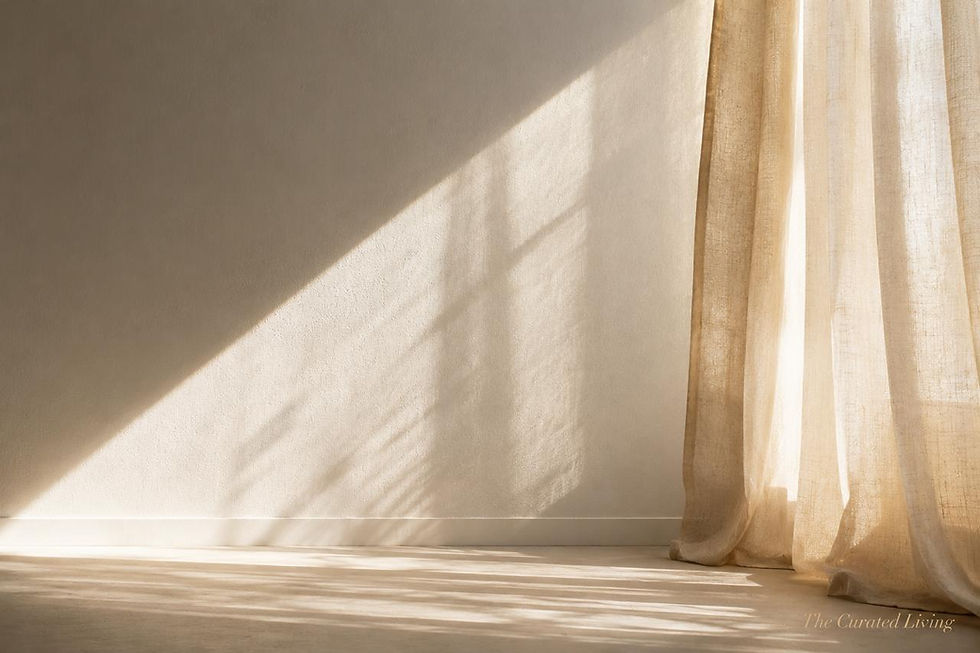
The transition line — the moving edge where light meets shadow through the day. This is often the most beautiful part of a room, and most people put a piece of furniture directly in front of it.
"Shadow zones aren't a problem. They're potential."
What You're Doing That's Blocking the Light
This section is uncomfortable, but necessary.
Heavy curtains closed during the day. This is the most common one. Curtains are for privacy and temperature control — not permanent fixtures. If your curtains are dark, lined, or floor-length and you keep them closed because they "look nice," you are living in a significantly dimmer version of your home than you need to.
Swap to sheers or lightweight linen panels for daytime use. Keep the heavier curtains for evenings. Your room will feel twice as large.
Furniture blocking windows. A sofa pushed against a window, a tall bookshelf adjacent to a glass door, curtain rods mounted too close to the frame — all of these interrupt the way light enters and disperses. Light should be able to travel into the room, not get absorbed immediately by the first large object it hits. Keep at least 60 to 90 centimetres in front of any window completely clear.
Dark floors in small rooms. Dark flooring is beautiful — but in a room that's already light-limited, a dark floor absorbs rather than bounces light back up. A large, light-coloured rug in the right spot makes a measurable difference.
Too much on the walls. Gallery walls add visual mass that makes a room feel denser. In a room that needs to feel lighter, edit what's on the walls rather than adding to them.

How to Amplify the Light You Have
Once you've stopped blocking what you already have, the next step is learning to stretch it.
Mirrors, placed intentionally. A mirror hung opposite a window doubles the light in that zone. A mirror placed on a perpendicular wall does far less. If you're going to use a mirror to add light, it should be facing the source, not parallel to it.
Gloss and satin finishes on walls. Matte paint absorbs light. Satin and eggshell finishes reflect it subtly — not in a shiny, obvious way, but in a way that makes the room feel brighter without you immediately knowing why. In rooms that are naturally dark, switching from matte to eggshell can make a noticeable difference.
Light-coloured ceilings, always. The ceiling is the largest single reflective surface in a room. If it's white, it acts like a diffuser — bouncing light from windows and lamps back down into the space. Keep ceilings white or very pale unless you are deliberately going for a dramatic, intimate effect.
Pale or warm-toned flooring. Stone, light wood, cream tiles — these all reflect light upward. If you're choosing a new floor finish, factor in how much your current floor absorbs versus reflects. It matters more than most people expect.
"A mirror should face the light source — not run parallel to it."
The Light You Don't Think About: Artificial Light After Dark
Natural light ends. What you have after that is the second half of your home's life — and it's equally worth thinking about.
The biggest mistake in artificial lighting is a single overhead source. A central ceiling light throws flat, even illumination across the entire room. It is functional. It is not beautiful. It flattens shadows, removes depth, and makes everything look like a waiting room.
What creates warmth at night is layered light — light at different heights, from different directions, at different intensities.
→ A floor lamp in a corner → A table lamp at seated level → Under-cabinet light in a kitchen → A pendant over a dining table, hung low enough to feel intimate
Colour temperature matters too. Warm white (2700K–3000K) feels like candlelight — right for living rooms and bedrooms. Cool white (4000K+) is energising — better for kitchens, bathrooms, and workspaces. Matching colour temperature across all light sources in a room creates immediate coherence.

Light Is the Design
Here is what architects know and most homeowners don't quite believe until they experience it: light is not something that happens in your home. It is the design itself.
You can have the most beautiful furniture, the most carefully chosen palette, the most considered layout — and if the light is wrong, none of it lands the way it should. Conversely, a simple, sparse room with excellent light feels rich. Feels thought-through. Feels like somewhere a person lives with intention.
Start with what you already have. Map it, stop blocking it, amplify it.
You might be surprised how different your home feels when you finally let the light in.
"A simple room with excellent light feels richer than a decorated room with poor light."
Want to go deeper into your home design?
Start with the free guides — no commitment, just good design thinking straight to you.
Start here — it's free: 👉 Download the Free Colour Starter Guide
Take it further: 👉 Colour Your Space Workbook — ₹199 for Indian buyers
👉 Colour & Your Home: The Complete Guide — ₹449 for Indian buyers
The essential starting point for every kitchen renovation.
The Compact Kitchen Design Guide by The Curated Living gives you that complete framework, with real market costs and a pre-execution checklist built specifically for this moment.


Comments