Home Lighting Design Tips - Why Your Home Feels Off

Updated: May 15

You have repainted the walls. You have changed the furniture. You have added plants, cushions, a rug that took three weeks to choose. And yet something still feels wrong. The room does not feel the way you imagined it would. It feels flat. Or harsh. Or just — off.
In most cases, the problem is not your furniture. It is not your colour palette. It is your lighting.
I have been designing homes professionally for over a decade and lighting is consistently the most underestimated element in residential interiors. People spend months choosing the right sofa and twenty minutes deciding on a light fitting. The result is a beautiful room that never quite feels right — because the lighting is working against everything else.
These home lighting design tips are drawn from over a decade of professional practice — and they apply to every room, every budget, and every home.
Here is what is actually happening, and how to fix it.
These home lighting design tips are drawn from over a decade of professional practice — and they apply to every room, every budget, and every home.
The Problem — One Light, One Plane
Most Indian homes are built with a single ceiling light point per room. A builder-grade fitting, centred on the ceiling, throwing light downward uniformly across every surface. It is functional. It is also one of the worst things you can do to a room.
A single overhead light source does three damaging things simultaneously. It flattens every surface by eliminating shadow and depth. It creates harsh contrast between the lit centre of the room and the darker corners. And it makes the ceiling — the least interesting surface in the room — the brightest thing in your field of vision the moment you look up.
The room ends up feeling like exactly what it is. A box with a light in it.
The Solution — Layered Lighting
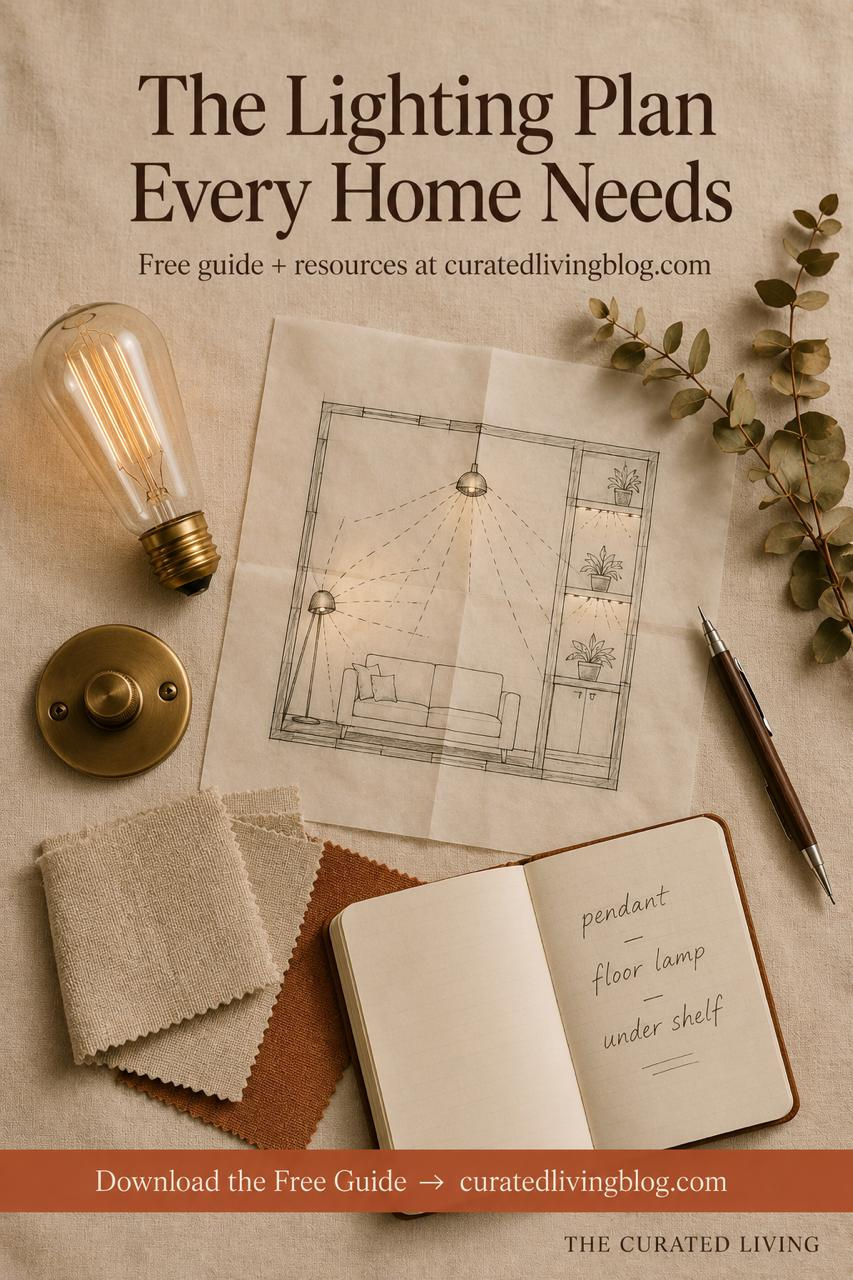
Layered lighting is not a design trend. It is a fundamental principle of how light works in space. The idea is simple: instead of one source at one height, you create multiple sources at multiple heights, each serving a different purpose.
There are three layers every room needs.
Ambient light is your base layer — the general illumination of the space. This does not have to come from the ceiling. A floor lamp in the corner, a pair of table lamps on either side of a sofa — these create ambient light that feels warm and human rather than institutional.
Task light is directed, functional illumination. Under-shelf lighting in the kitchen so you can actually see the counter. A reading lamp positioned correctly beside a chair. A pendant light over a dining table that illuminates the table surface rather than the ceiling above it.
Accent light is the layer most people skip entirely. It is light used decoratively — to highlight a plant, to wash light up a textured wall, to backlight a shelf of books. It adds depth and dimension that no amount of furniture or accessories can replicate.

Room by Room — What Actually Works
Living Room
Turn off your main ceiling light. Now add a floor lamp in one corner, a table lamp on a side table or console, and if you have a bookshelf — a small LED strip behind or under the shelves. That is your living room lighting. It will feel warmer, moodier, and more dimensional than it has ever felt before.
The ceiling light becomes your utility light — used only when you need to find something or clean. It is not your primary source.
Bedroom
The bedroom is where single overhead lighting does the most damage. Harsh light from above at eye level when you are lying down is deeply uncomfortable — and it signals to your brain that it is time to be alert, not to rest.
Bedside lamps are not a luxury. They are a functional necessity. One on each side of the bed, at the right height — roughly level with your shoulder when sitting up — transforms the entire experience of being in that room at night. Add a small lamp on a dresser or console if you have one. Let the ceiling light retire.
Kitchen
The kitchen is the one room where task lighting matters more than atmosphere. Under-cabinet lighting is transformative — it illuminates the counter directly where you are working, eliminates shadows cast by overhead lights, and makes the entire kitchen feel more professional and considered.
If your kitchen has open shelves, a small LED strip underneath each shelf does double duty — it lights the counter below and highlights what is displayed above.
Bathroom
Side lighting around a mirror — rather than a single light above it — is one of the most significant upgrades you can make to a bathroom. Overhead mirror lighting casts unflattering shadows downward. Side lighting at face height is even, flattering, and far more functional for everything from skincare to getting ready.
A small warm lamp on a surface, if space allows, adds the kind of softness that makes a bathroom feel like a space to pause rather than just a utility room.

The Colour Temperature Question
Every light bulb has a colour temperature measured in Kelvin. This is the difference between light that feels warm and golden versus light that feels cool and clinical.
For living spaces — bedrooms, living rooms, dining areas — you want bulbs between 2700K and 3000K. This is the warm white range. It is the colour of candlelight, slightly brightened. It makes skin look good, makes rooms feel inviting, and works with warm interior palettes rather than against them.
For kitchens and bathrooms where you need clarity and accuracy — 3000K to 3500K gives you warmth without sacrificing the visibility you need.
Avoid anything above 4000K in a home unless it is a dedicated workspace. Cool white and daylight bulbs belong in offices and hospitals, not in spaces designed for rest and living.
This one change — simply replacing your existing bulbs with the right colour temperature — will immediately change how your home feels. It costs almost nothing.
Dimmers — The Most Underused Tool in Interior Design
A dimmer switch is not a luxury fitting. It is the single most cost-effective upgrade you can make to any room.
The ability to control the intensity of light at different times of day completely transforms how a room functions. Bright for morning routines. Medium for working from home. Low and warm for evenings. The same room serves three completely different moods without changing a single piece of furniture.
If you are doing any electrical work — a renovation, a new fit-out, even just replacing a switch — always install a dimmer. You will use it every single day.
Where to Start
You do not need to rewire your home or buy expensive fixtures. Start with what you have.
Buy one good floor lamp and place it in the corner of your living room. Replace your existing bulbs with 2700K warm white bulbs. Turn off the ceiling light in the evening. Live with that for one week.
The difference will be immediate and significant. And once you see it, you will not be able to unsee it.
Lighting is not the finishing touch. It is the foundation that makes everything else work.
Want to go deeper into your home design?
Start with the free guides — no commitment, just good design thinking straight to you.
Start here — it's free: 👉 Download the Free Colour Starter Guide
Take it further: 👉 Colour Your Space Workbook — ₹199 for Indian buyers
👉 Colour & Your Home: The Complete Guide — ₹449 for Indian buyers
The essential starting point for every kitchen renovation.
The Compact Kitchen Design Guide by The Curated Living gives you that complete framework, with real market costs and a pre-execution checklist built specifically for this moment.


Comments